
My Personal Perspective of Traditional vs. Digital Art
- Alyssa Cervantes
- Apr 21
- 4 min read

Traditional art and digital art represent two distinct methods of art creation, and surprisingly, when digital art initially gained popularity, many in the art community claimed that digital art was not art. My parents held this belief as well, leading to frequent debates at the dinner table when I first ventured into the digital art realm. My counterargument? While digital art does offer easier access to tools for color, shading, and more, as a new artist, you still need to learn how to effectively use these tools. You're mastering an entirely new system. You are still creating, all while learning to utilize software to enhance your creations. Therefore, you are still putting in the time, effort, and patients to create an art piece just as you would with traditional art; digital art is still art. With that said, let's get into today's post!
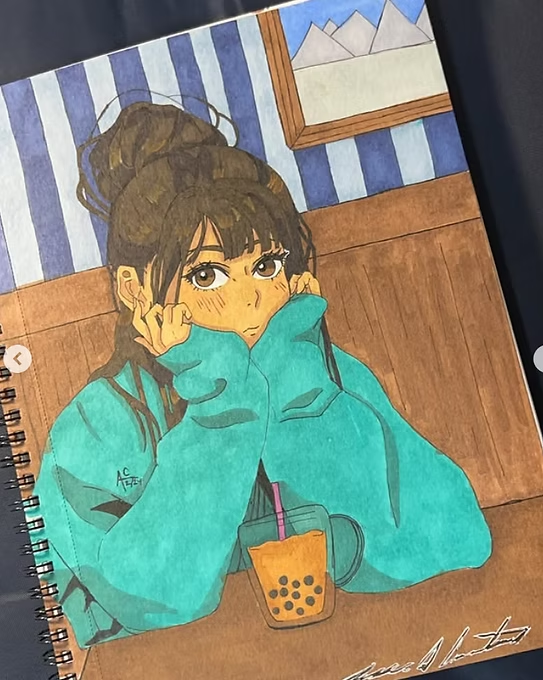
Traditional Art
Traditional art has been around for centuries. It is one of the original forms of how individuals would express art whether that be through painting, sculpting, weaving, pottery and more. Up until today, traditional art is still widely used to express emotions, imagination, tools and ideas.
As amazing as today's technology is, nothing beats creating a new world on a blank, physical page.
Traditional art was the first thing that sparked my interest in creation. It started with sketching, to line art, to working with color. I was comfortable in drawing cartoon-like characters, eventually expanding my interests in realism, although it's only something I prefer to do once in a lifetime, as cartoonish styles is what sparks my interest the most.

Digital Art
For a long time, I didn't get into digital art because I didn't understand the process. I wasn't aware of the specific software required, and I didn't know how people initially drew with their fingers (though I now realize that's not the case). When I first discovered how to create digital art on my phone, I was thrilled. Eventually, I saved up for my own iPad and continued to teach myself digital art through Procreate, gradually improving while trying to balance my new college life.
As I learned to use this new software, I also enrolled in a college animation course. This experience broadened my understanding of digital art, for which I am always grateful, even though it was one of the most challenging classes I have ever taken.
My First Commission
Now let's talk about one of the most difficult processes an artist can take on... commissions. My first ever paid commission was when I was in my senior year of high school. I had a teammate from school ask if I could draw her something related to Dragon Ball Z and she would pay. As nerve wracking as it was, I said yes.
I was terrified.
I am terrible at drawing male anatomy, and I had never drawn a style that was so out of my comfort zone. So, I practiced.
What started out as fear, turned into one of my most favorite pieces I had ever done. It made me realize that I could create anything I wanted, no matter how much practice it took. I had proved to myself that anything could be possible, and the sky was the limit when it came to creativity.
Timelapse of most recent piece
Interestingly, one of my favorite activities is reviewing the timelapse that Procreate offers to observe my progress on a piece. It inspires new ideas and helps me identify what might need adjustments. Additionally, if I ever feel uncertain about my project's appearance, revisiting the timelapse reassures me that it looks better than when I began. For those interested, I've uploaded one of my recent timelapses... feel free to check it out!
Final Thoughts
Overall, I have overcome many challenges when it comes to the improvement of my art, ranging from technical skills to emotional expression. Each obstacle has served as a valuable lesson, shaping my artistic journey in profound ways. For instance, I have faced difficulties in mastering various techniques, such as shading and color theory, which initially felt too great to overcome at times. Through persistent practice and the willingness to learn from critiques, I gradually began to see progress in my work. Moreover, the creative process itself has presented its own set of hurdles. There have been times when I struggled with self-doubt, questioning my abilities and the validity of my artistic voice. However, these moments of uncertainty have often led to breakthroughs, prompting me to explore new styles and mediums that I might not have otherwise considered. Additionally, I have encountered challenges in finding inspiration, especially during periods of artistic block. To combat this, I have sought out new experiences, engaged with fellow artists, and immersed myself in different cultures and environments, all of which have enriched my perspective and fueled my creativity. Despite these accomplishments, I recognize that there will always be more room for improvement. The art world is ever-evolving, with new techniques, trends, and ideas emerging constantly. I am committed to lifelong learning, whether through formal education, workshops, or self-directed exploration. This mindset not only keeps my work fresh and relevant but also allows me to push the boundaries of my artistic capabilities. In conclusion, while I have made significant strides in overcoming various challenges in my artistic journey, the path of improvement is ongoing, and I eagerly anticipate the growth and discoveries that lie ahead.


Comments